The context graph beneath the revenue layer
Every account, conversation, and signal across your stack, resolved into one live graph of relationships your team and your agents act on.
Access is not context





Claude reaches every tool, but sees the same account as five different records. It has the data, and no idea which identity is real.

Nous resolves every record into one identity, current and complete, so Claude works from what is actually true about the account.
Inside the context graph
Account intelligence
Every person, conversation, and touchpoint resolved into one live account record, so you see the full buying committee and exactly where each deal stands.


Identity resolution
Every person, company, and touchpoint resolved into one record across every tool you run, so the same account is never four different rows.
Your definitions
Your ICP, your stages, and what qualified means to you, encoded once and shared by every teammate and every agent.
Freshness on every fact
Every fact carries its freshness, so your team and your agents never quietly act on data that has gone stale.
Full account memory
The complete history of every account, so no conversation and no agent ever starts from a blank slate.
Data ingestion
Governance and permissions
Scoped to every user
An agent sees exactly what that person is authorised to see, and nothing they are not. No colleague's inbox, quota, or paystub.
Governed before ingestion
A multi-layer rule engine decides whether each piece of raw data is even ingested, by role and access.
Object, record, and field level
One permission model across every system, reduced to simple primitives you can actually reason about.
Checked and logged
Every fact an agent reads passes through the governance layer, and every access is written to an audit trail.
How to use the context graph
Revenue agents inside Nous
Specialised agents that run on your context graph. Ask anything about an account, or run a skill, right where the work is.
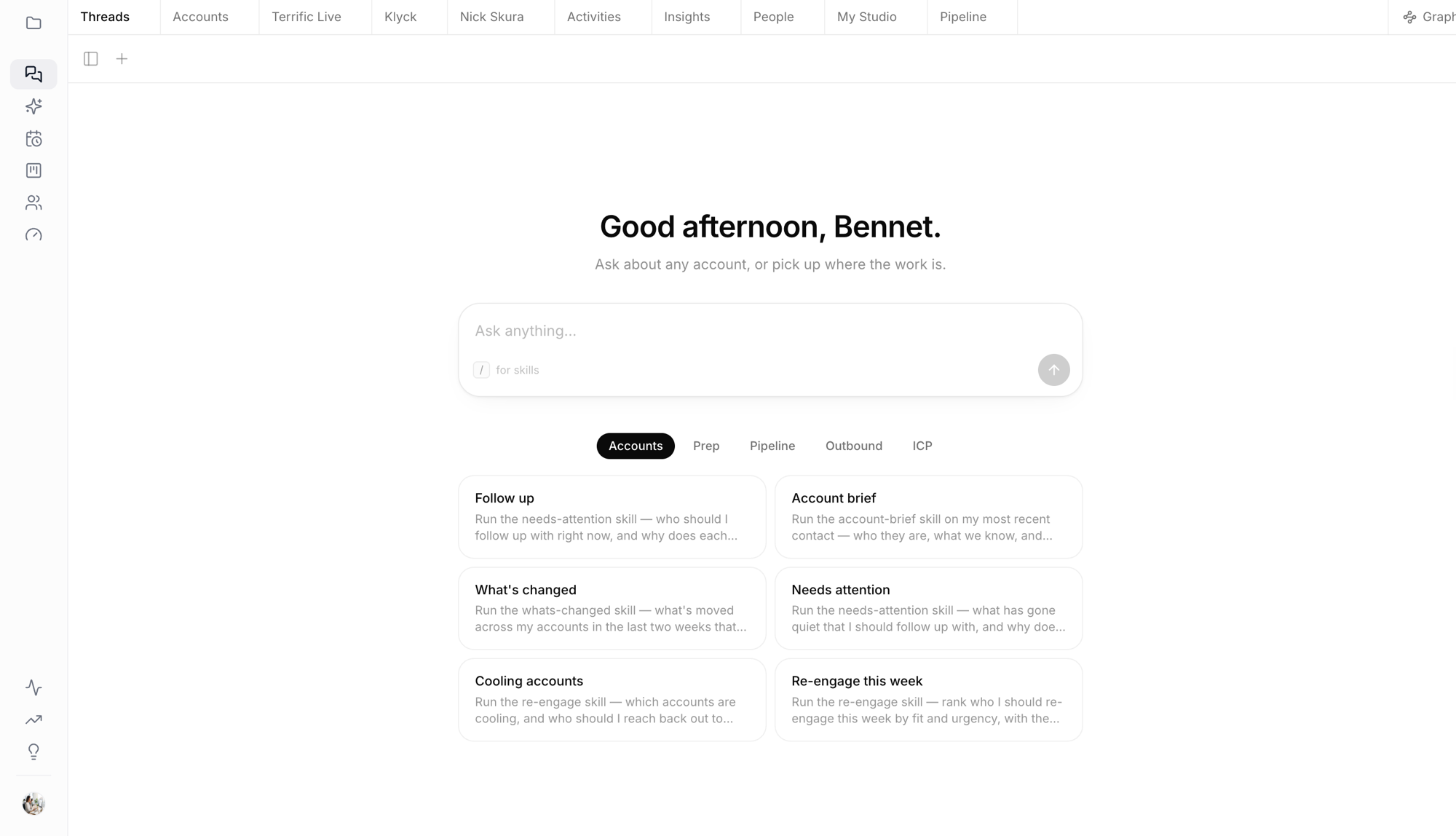
Connect via MCP
Connect Claude, Codex, Cursor, or any agent to the context graph over MCP, and it reads the same truth your team does.
Read the MCP docs

Run Nous inside your terminal
Nous plugs straight into Claude Code and Codex, so the agents your team already runs read the same revenue layer you do.
npx @opennous/cli init